
New Zealand’s beef supply is likely to lift modestly in 2026, supported by strong pricing signals and improved confidence across finishing systems, according to Rabobank’s Q1 Global Beef Quarterly report.
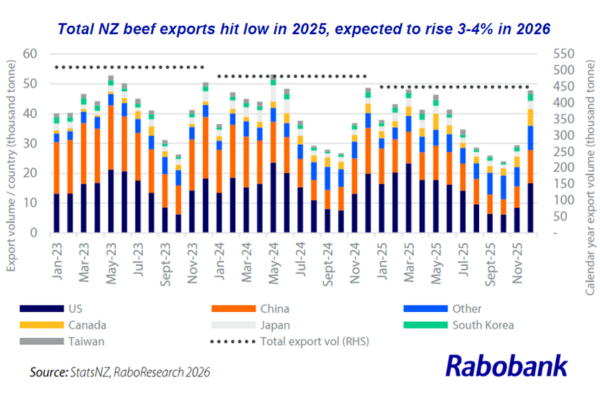
Rabobank says the 2025 New Zealand season marked a production low, with the country’s smallest annual beef output since 2017 at just under 674,000 tonnes (down 6% vs 2024) – largely due to fewer dairy-origin calves reared in 2023 and reduced dairy cow culling as a strong early season milk price held cow numbers steady.
“This lower beef production dynamic is shifting as an estimated 150,000 additional dairy-beef calves were reared in 2025, expanding the pool of Rising 1 (R1) cattle coming through,” report co-author, senior animal proteins analyst Jen Corkran said.
“And we’re expecting slaughter numbers will rise by around 3% in 2026, increasing total production output.”
Ms Corkran said summer 2025/26 has so far delivered very favourable grass-growing conditions across the country.
“This has enabled farmers to hold stock longer and add additional weight. While positive for productivity, this does contribute to localised procurement challenges at times, even as export demand holds firm,” she said.
The report says New Zealand beef export volumes are expected to increase by 3-4% in 2026, in line with higher production.
“Export volumes dipped to approximately 447,000 tonnes in 2025, but are expected to bounce back in 2026 which will help restore some processing throughput, though without significantly easing competition for cattle,” Ms Corkran said.
Ms Corkran said farmgate beef pricing has held at record levels across the first two months of 2026, supported by strong offshore demand.
“By February, the AgriHQ North Island bull indicator had reached $9.65/kg CWT, an all-time high, and premiums on top, meaning some producers may be getting closer to $10/kg,” she said.
“December 2025 saw the average export value for New Zealand beef reach $12.42/kg FOB, another record, reflecting both a supportive currency (at the time), and broad global demand.
“The US continues to dominate New Zealand’s export mix and is likely to do so again in 2026, given low US cow supply and elevated lean-beef values.”
Global outlook
The report says, global cattle prices continue to track in a positive direction.
“Even in North America where prices dipped slightly in late 2025, prices have returned to an upward trend in 2026,” Ms Corkran said.
“Cattle prices in key production regions around the world are increasing or remain near record highs as global beef supply starts to tighten. And with further contraction expected in 2026, the outlook for beef prices remains strong.”
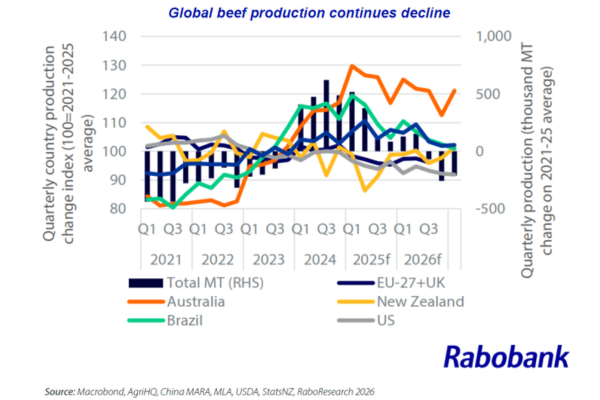
The reports says lower production volumes, compared to the 2020-24 average, in the US, New Zealand and Europe continue to pull the total beef supply down.
“Cattle inventory numbers reported by the US in early February 2026 show the beef cow herd at the lowest levels in 75 years. By the middle of 2026, RaboResearch expects production out of major global suppliers to dip below the average volume of the last five years,” Ms Corkran said.
“Exports in Brazil pushed to new record levels in January supporting demand in northern hemisphere countries, but we believe volumes in Brazil will contract through 2026.
“Australia is one of the few countries with production volumes remaining relatively stable and above the five-year average.”
New Chinese quotas set to reshape beef trade flows
Ms Corkran said China remains a major watchpoint for producers in New Zealand and other beef-producing regions around the globe, following recently-announced quotas on beef imports.
“China began implementing a three-year import quota system on 1 Jan 2026 as part of its safeguard measures following a year-long investigation into the impact of rising imports on domestic cattle producers,” she said.
“The total quota for 2026 is set at 2.688 million MT, with some of the specific quotas being Brazil (1.106 million MT), Australia (205,000 MT), and the US (164,000 MT). The quota will increase by 2% in the second year and 1% in the third year, to 2.742 million MT, and 2.787 million MT, respectively.”
“And as the world’s largest beef importer, China’s policy is expected to reshape global trade flows and increase market volatilities.”
Ms Corkran said New Zealand’s beef quota into China for 2026 is 206,000 MT, with any exports above this facing a 55% tariff.
“New Zealand beef exports to China have been lower in recent years and these could lift by around 40% from 2025 levels before hitting the quota,” she said.
“With only a modest production lift expected in 2026, and strong US demand, reaching the quota looks unlikely.
“That being said, major beef exporters like Australia and Brazil are expected to hit their quotas, and the redirection of beef flows from these countries will be a key-watch point in the second half of 2026.”
RaboResearch Disclaimer: Please refer to our RaboResearch disclaimer here for information about the scope and limitations of the material published.