
More students across New Zealand can now build their food an agri knowledge with Grow, an agri-focused board game launched in 2022, following the release of a new set of Grow Junior cards.
The original Grow game and card set was developed to support learning by year 11 students studying NCEA Agribusiness and Agricultural & Horticultural Science and continues to be used widely across secondary schools – particularly as a revision tool in preparation for Year 11 exams.
Following feedback from teachers that a Grow Junior card set would help increase the game’s use, a new set of cards was developed and made available to schools earlier this year. The new card set can be used in conjunction with the original Grow board and includes agribusiness-related questions suitable for students in years 9 and 10.
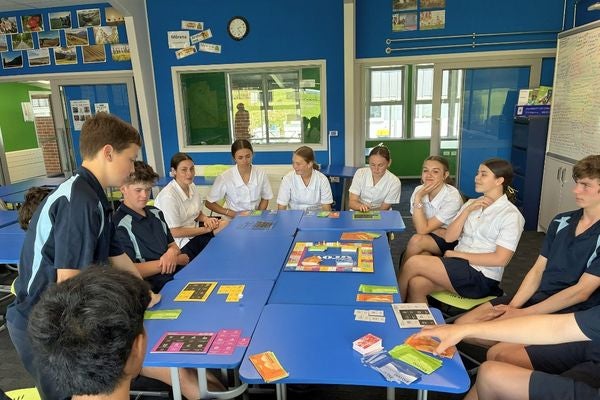
Feedback on new card set
Agricultural Science teacher Sarah Stark from Northern Southland College – one of the more than 125 secondary schools across the country utilising the Grow game – said she was utilising the new junior cards with her year 7 to 10 students.
“Northern Southland College is very rural, so it’s a great school to teach agriculture at because the kids are into it and generally know a wee bit about the subject,” she said.
“We’ve offered agriculture as an elective subject for quite a few years now for our year 9 and 10’s, and they to do it for half a year, while for our year 7 and 8’s, all students do agriculture but just for one term.
“The original Grow questions were very targeted towards the Year 11 ag/hort science course content, while the new ones are a bit more general. I’ve found the new cards fantastic and have been using them in agricultural classes with our students from year 7 to 10.
“I’ve split up the questions and use the easier ones with my year 7 and 8 students, while the slightly harder questions are used with my year 9 and 10s.”
Because agriculture was not assessed via exams for year 7 to 10 students, Ms Stark said, the Grow game was used as a bit of a reward with these students, rather than a revision tool.
“The students just love the game, and there’s a good range of questions so it’s a good test for them,” she said.
“At our recent year 10 options afternoon where we discussed course selection for next year, many of the students were asking about whether they would still get to play the Grow game in Year 11.
“It’s certainly something they enjoy at the year 9 and 10 level and is helping generate interest in further agri study going into year 11.”
Grow development
Rabobank New Zealand CEO Todd Charteris said the initial idea for Grow came about following discussions between Rabobank’s Upper South Island Client Council – a group of the bank’s clients from the upper half of the South Island who meet regularly to discuss the challenges facing the agri sector – and Lincoln University.
“Building long-term industry capacity is one of the key challenges identified by our Client Councils,” he said.
“Through conversations with Lincoln University and the Agribusiness in Schools programme, we identified a need for more resources to help secondary school students learn about food production. Developing a board game together was a great way to bring that learning to life and to demonstrate the diverse skills and knowledge involved in running a successful farming operation.
“The agricultural sector is such an important one for New Zealand’s economy, and it’s fantastic to hear the new Grow Junior card set is helping to increase students’ knowledge and interest in the industry.”
Gameplay
The Grow game focuses on the financial, social, and environmental aspects of food production. Up to six players can participate in the game, with all players initially allocated a piece of land and sum of money before choosing if they wish to operate a dairy, sheep and beef, horticulture, viticulture, or arable farming operation.
Gameplay consists of players moving around a board and accumulating money which then gives them an opportunity to purchase the required assets to operate their farm. Players must first successfully answer a question to collect an asset, and the first player to collect all the assets required for their farm wins the game.