
Lower supplies, higher costs, margin pressures, and shifting trade patterns are set to shape the 2027 global beef market, while New Zealand farmgate beef prices are expected to remain relatively firm, according to a new report by food and agribusiness banking specialist Rabobank.
In its Q4 Global Beef Quarterly Rabobank says the 2027 season is likely to follow a similar pattern to what has played out across 2026.
“RaboResearch projects a 0.1% decline in global beef production in 2027, following an estimated decrease of 1.5% in 2026, with most major producers likely to see a drop,” RaboResearch senior agricultural analyst Jen Corkran said.
“If global production plays out as we expect, 2027 will be the second year in a row of decreasing production and the first time since 2015 we have experienced consecutive years of contraction.
“Brazilian beef production is forecast to contract 3% and the EU+UK and China are likely to be down 1% each.
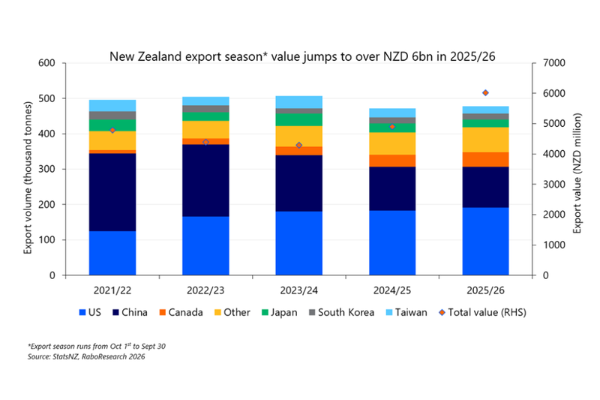
New Zealand Export Season Graph 2025/26
“Two countries bucking the trend are New Zealand and our Trans-Tasman cousins Australia, who are projected to see growth of 8.8% and 3.5% respectively.”
Ms Corkran said key input costs are forecast to remain high amid the ongoing conflicts in the Middle East and between Russia and Ukraine.
“Although oil, diesel, and other fuel costs are expected to decline slightly, they will remain historically high throughout 2027 due to the supply restrictions and increased risks and costs of fuel production,” she said.
“Feed prices in global markets are expected to be slightly higher in 2027, although uncertainty remains in the market. Underlying fundamentals of high grain stocks and reasonable harvest volumes suggest supplies should be adequate. However, seasonal conditions and the potential for supply disruptions from the Russia-Ukraine conflict could lead to short-term price volatility.”
Ms Corkran said since Australian and Brazilian beef exports to China reached their quotas in July and September respectively, exporters have redirected volumes to other markets, disrupting global beef trade.
“Amid this disruption, the US president announced a new zero-tariff quota of 300,000mt in late August for suppliers in the category of “other countries.” This category includes Brazil, which has faced a 26.4% duty on all beef exports to the US since the 65,000mt quota ran out in January,” she said.
“The US planned to divide the new quota into 100,000mt shipments in September, October and November. However, at the time of writing, estimates put shipments under the new US quota at 40,000mt in September and 45,000mt in October.
“We expect Australia and Brazil are preparing their supply chains in quarter four for the start of China’s new quota year on January 1. These preparations would position beef to clear Chinese import procedures under the new year’s quota once it opens.”
Consumers’ price tolerance
With limited global beef supplies pushing global beef prices to record highs across many regions, the reports says, consumers’ price tolerance is being tested.
“That tolerance will exert a strong influence on beef prices, and ultimately cattle price movement throughout the coming year,” Ms Corkran said.
“Current high retail prices limit the ability to pass additional costs through the system, leading to margin pressure and reduced profitability.”
New Zealand update
The report says New Zealand beef production for the first three quarters of 2026 is up ~6% year-on-year driven by a 4.5% increase in total headcount processed in the calendar year to the end of quarter three.
“Farmgate cattle prices remain historically strong, but slightly weaker US manufacturing beef prices over recent months have led to some downside pressure for bull and cow prices more recently,” Ms Corkran said.
“The weaker US market likely reflects increased competition from Brazilian beef, additional Australian product seeking alternative markets, and reduced urgency among US importers to secure supply.
“This is particularly relevant for New Zealand given lean manufacturing beef accounts for most of its beef exports to the US. The resetting of global tariff and quota settings in early 2027 will be an important watch for Kiwi producers.”
Ms Corkran said recently released export values for the 2025/26 season – which runs from October 1 to September 30 – show the value of New Zealand beef exports jumped to over $6bln for the first time.
“The US and China accounted for around two-thirds of total beef export volumes with Japan, South Korea, and Taiwan also key export destinations,” she said.
Looking ahead, Ms Corkran said, farmgate prices are expected to remain relatively firm, with some seasonal softening as cattle availability increases.
“Prime and bull slaughter typically rises from November through January. Weather will influence weight gain and the timing of turnoff, affecting production and processor procurement pressure,” she said.
“A faster lift in supply would increase downside pressure on schedules. However, overall prices are expected to remain historically firm throughout 2027.”
RaboResearch Disclaimer: Please refer to our disclaimer here for information about the scope and limitations of the RaboResearch material provided in this media release.