
Twenty-five secondary school students from around New Zealand recently completed a three-day residential programme designed to explore career opportunities across the food and fibre production supply chain.
Held from 7–9 July, the Farm2Future educational camp – which was fully funded by Rabobank and run by Lincoln University – brought together Year 12 students from 20 schools nationwide. During the programme, participants visited a range of agribusinesses throughout Canterbury, including Rakaia Island Dairy Farm, Oakley’s Premium Fresh Vegetables, PGG Wrightson, Original Foods, Zentera Wool Company and Foodstuffs.
Students also attended a presentation by Sudeley Angus and Sheep Stud, heard from a panel of young agribusiness professionals about their roles and career pathways, and toured Lincoln University to gain further insight into agricultural education.
Rabobank Upper South Island Client Council Chair and Oakley’s founder Robin Oakley said Farm2Future was originally developed by Rabobank and Lincoln University in response to a need to raise awareness of the diverse career opportunities available within New Zealand’s food and fibre sector among secondary school students.
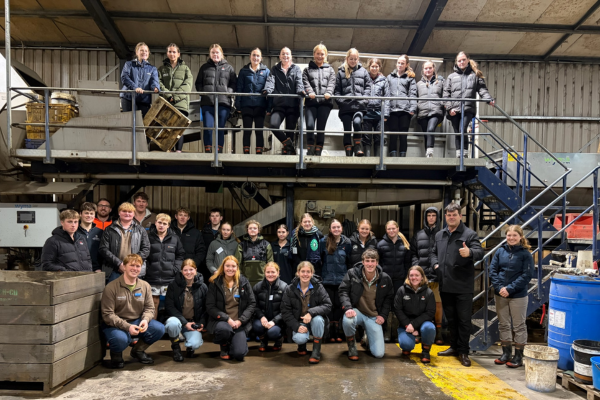
Visit to Oakley’s Premium fresh Vegetables – Robin Oakley second from right at ground level
“The programme was first run back in 2019 as FoodX and, after a few years break, it’s run annually since 2023. In 2024 the programme was renamed Farm2Future with the Lincoln University Future Leaders scholars – a group of Lincoln University students with strong academic backgrounds and leadership potential – taking over the running of the programme,” he said.
“I really enjoyed hosting the group at Oakley’s vegetables and providing them with a bit of information about the business and the different roles carried out by the Oakley’s team.
“They all seemed genuinely engaged in the visit and asked some sensible questions.
“I also had the opportunity to award attendees with their course completion certificates at the programme prizegiving, and there was a real sense of achievement amongst the group at what they’d accomplished over the last few days.”
Mr Oakley said the programme is run by students for students and this was fundamental to its success.
“It is run by students only two to four years older than the year 12 students attending and, like many of the students attending the camp, many of the Future Leaders scholars have come from urban backgrounds.”
Mr Oakley said this year’s programme participants were selected from more than 80 Year 12 students who applied to attend.
“There was plenty of interest in attending the camp and much of this interest came from female students,” he said.
“More than three quarters of the applications came through from females, and we ended up with 19 females on the course and six males.”
“The United Nations has declared 2026 as the Year of the Woman Farmer, and it’s fantastic to see so many young Kiwi females showing interest in a sector which has traditionally attracted a higher proportion of male workers.”
One of the participants on the programme Keira Cocks, said the camp included a good variety of visits that gave her new insights into the agricultural sector.
“My highlight from the camp was meeting more like-minded people, forming new friendships and hearing directly from industry professionals,” she said.
“It gave me authentic, real-world insights that went beyond what is taught to me in the classroom. I enjoyed hearing about their businesses, day to day roles, and career journeys.”
Ms Cocks, who attends Cashmere High in Christchurch, said she learnt the most from the programme panel session.
“My biggest learning came from the panel session and hearing about the panellists’ individual experiences, backgrounds, and career pathways,” she said.
“I especially enjoyed hearing from the panellists who had roles similar to what I am considering doing in the future. I also learnt through the visits and talks that you have to put yourself out there, take any opportunities on offer, and be willing to learn.”
Another of the participants, Milan O’Neill from Lincoln High School southwest of Christchurch, said the programme had exceeded her expectations.
“It was way more interesting and eye opening than I’d expected,” she said.
“I really enjoyed visiting all the different operations and I discovered there were way more opportunities in the sector than I’d originally thought there would be.”
Ms O’Neill said she’d enjoyed getting behind the scenes to see how things work, as well as learning about peoples journey to get to where they are.
“A fair few of the people that we heard from hadn’t come from farming backgrounds or gone to Uni, and it was interesting to hear how they started at the bottom and have made their way up.”