
New Zealand remains the world’s largest single-country dairy exporter accounting for 22.1% of world dairy exports in 2025, according to Rabobank’s 2026 World Dairy Map.
The new map and accompanying report – which examine key trends and trade flows in global dairy for the period 2017 to 2025 – highlight global dairy trade grew by 11% across this time frame, increasing from around 91.1 billion kg in liquid milk equivalents (LME) in 2017 to 101.2 billion kg in 2025.
Rabobank senior agricultural analyst Emma Higgins said the map and report highlight New Zealand’s consistent contribution to world dairy exports across this period.
“If we look back across the last eight years, New Zealand’s contribution to global dairy exports has held remarkably steady, oscillating between a high of 23 billion kg (2019 & 2021) and a low of 21 billion kg (2017, 2018 & 2022). And since 2023, New Zealand’s contribution has held constant at 22 billion kg,” she said.
“With overall dairy trade having increased, New Zealand’s market share has dropped slightly, but it is still contributing well over a fifth of all global dairy exports.”
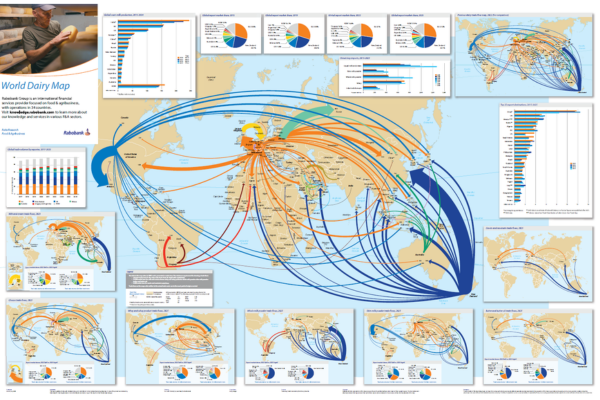
Rabobank World Dairy Map 2026
The report says the EU bloc continues to be the world’s largest dairy exporter overall – accounting for 27% of world dairy exports in 2025 – however their export share is also slowly eroding.
“Back in 2017, the EU was responsible for closer to 30% of all global dairy exports, but since then we’ve seen their overall share driven lower by falling exports into China.” Ms Higgins said.
“A major contributor to this fall is China’s liquid milk market, where imports have declined significantly in recent years. European exporters have borne much of that impact, while New Zealand has maintained stable export volumes and has become China’s largest supplier of imported liquid milk and cream since 2024.”
The report says the US – the world’s next largest global dairy exporter behind the EU and New Zealand – has grown dairy exports across recent years.
“Since 2017, we’ve seen the US build export growth momentum and they’ve expanded their share of global export volumes from 11.3% in 2017 to 13.5% in 2025,” Ms Higgins said.
“Smaller dairy players are also gaining export ground with Argentina and Uruguay combined now accounting for 4.3% of total dairy exports, up from 3% eight years ago,” she said.
Global dairy demand shifting from China toward emerging growth hotspot
On the demand side, the report says, China remains the heavyweight importer, despite a steady downward trend in imports from a peak in 2021.
“The decline is particularly striking in key categories such as liquid milk, cream and milk powders, where imports have halved over the past four years on the back of strong domestic production and weaker demand,’ Ms Higgins said.
“However, as China’s demand softens, other regions are stepping to fill the gap including markets in the Middle East, Southeast Asia and Brazil.”
Dairy product category performance
The report says there have been substantial differences in trade performance over recent year across dairy product categories, with cheese the undisputed engine of dairy trade across the last decade.
“Since 2017, cheese has delivered consistent strong growth, cementing its position as the standout performer in the dairy complex,” Ms Higgins said.
“By 2025, global cheese trade had reached 8.96 billion kg, an impressive 40% increase compared to 2017 with growth particularly strong across recent years.”
Ms Higgins said trade in milk powders – which makes up the lion’s share of New Zealand dairy export earnings – had been subdued.
“Exports of skimmed milk powder (SMP) edged up by just 0.5% in 2025, a modest increase that falls short of the growth in milk availability across major exporting regions. This subdued performance is not new, rather, it reflects a longer-term pattern of restrained growth in global SMP trade. Within this landscape, the EU and the UK have managed to increase their share of global exports, supported by stronger milk supply,” she said.
“The market for whole milk powder (WMP) mirrors this subdued pace of growth, but with a very different competitive structure. Here, New Zealand remains firmly at the centre, accounting for 56% of global exports in 2025, a share that has remained remarkably stable over time.”
RaboResearch Disclaimer: Please also refer to our disclaimer here for information about the scope and limitations of the RaboResearch material provided in this media release.