
Posted on
28/07/2025Since bravely tipping the family farms into a unique hybrid of family and corporate structures 17 years ago, 55-year-old Mark Chrystall is just as in love with farming as ever.
In 2008, Mark and wife Jane threw their lot in with Mark’s brother Richard and wife Ju, along with longstanding business partners Rob and Amanda Collier.
“We jointly formed Spring Farms (NZ) Limited to create a farming operation where the model has proved itself to deliver a whole that’s much greater than the sum of the parts today,” says Mark.
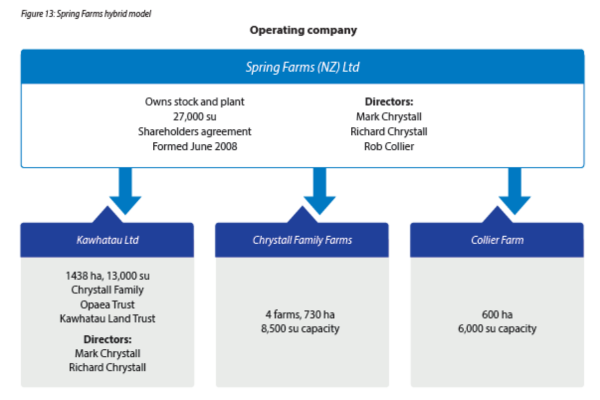
The hybrid model means that Spring Farms only owns stock and plant, and it leases all the land from the family land-owning entities (Figure 13). Spring Farms is set up as a limited liability company, which Mark views as simpler than a trust structure when it comes to transferring equity. The operation runs around 27,500 stock units (su) on 2,768 hectares of land, spanning flat to rolling hill, medium hill and some steep hill country around 20 km east of Taihape. The Chrystall family own 65% of the enterprise and the Collier family owns 35%.
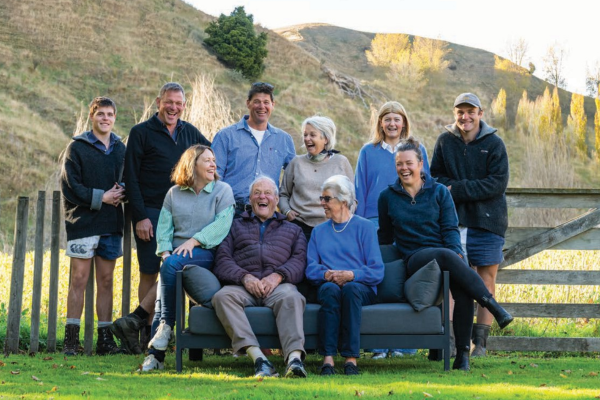
The Chrystall family story
The home farm on the Chrystall side of the equation has been in the family for more than 100 years. Mark’s grandfather bought the farm in 1921 and added to it as the Depression bit in 1929.
Like many New Zealand farm stories, it’s a male lineage. Ultimately, guardianship of the home farm came to Mark and his brother through their father, who was born in 1939 and took over the farm in the early 1960s.
“We were very fortunate because our parents had a philosophy to put their boys onto a debt-free farm. It didn’t quite work out like that. We did have some debt, but not a huge amount,” says Mark.
As was often the way at the time, there was no expectation that their sister Victoria would stay on or own and work the farm. In this case, a fair succession was enabled through the existence of off-farm investments held by Mark’s mother – who had always maintained a degree of financial independence.
“Mum was a city girl – her parents owned W&R Smallbone Limited, importing cars and liquor. There’s a family story about Mum’s culture shock when she arrived on the farm after getting married. She and Dad went into town to do the grocery shopping. Mum threw a pound of butter in the trolley. Dad looked at it and said, ‘You better buy more than that, we won’t be coming into town for another month’.
“When Mum and Dad retired in 2003, it was Richard’s and my turn to step up,” says Mark.
By this time, Richard had around 12 years’ on-farm experience under his belt, including head shepherd roles on an East Coast station and six years with Brownrigg Agriculture, where he ended up managing beef procurement. In 2006, Richard also started working for Ātihau-Whanganui Incorporation, finishing as Operations Manager in 2013/14, so with plenty of skills to bring home.
“I’d learnt enough to know that you can’t just farm with Dad’s diary. We’re both production focused, but our biggest limitation was ourselves – we needed to upskill. Our weakest area was governance and accounts. I tackled that through a rural executive programme run by our bank. That was a true catalyst for my growth and saw us embracing a growth strategy.”
Joining forces
Fuelled by this hunger for growth, they joined forces with long-term district identities Robert and Amanda Collier to set up Spring Farms in 2008.
In 2009, the brothers (with a Dutch partner taking a 60% stake) added to their holdings with the purchase of the 990 hectare Kawhatau block. They have since added a further 305 hectares in 2018 and 242 hectares in 2023, taking the Kawhatau farm to 1,438 hectares.
This was also leased into Spring Farms, and the Dutch partner later exited the investment.
In these early days of the operation, the brothers, along with the Colliers, began to forge the division of labour that powers Spring Farms today.
Mark does accounts and payroll and deals with banks, lawyers and relationships such as the fertiliser companies, while Richard leads day-to-day management on farm.
Robert’s areas of speciality are strategy and the overseeing role on the Ngata farm. Spring Farms also has another four full-time employees.
“When we set up Spring Farms, we had lots of eyes on us – and people saying it wouldn’t last. But we’re pretty passionate about outside capital and the discipline this hybrid model brings. It emphasises family values, but pulls out the best of doing things professionally,” says Mark.
The three directors, Mark, Richard and Robert, formally meet four times a year to review budgets, performance and cash flows.
“Although we are set up to have a fourth director, we have never appointed one. There’s no reason for it just yet,” says Mark.
The aspirations for setting up Spring Farms were to improve productivity, use economies of scale and use the company structure as a vehicle to distribute funds back to shareholders.
Mark still cites the original goals and says they are just as strong today:
- To operate a successful business in the top 2% for our chosen land classes.
- To be environmentally sustainable.
- To be able to adapt to climate change, i.e. drought-proof the business.
- To make technology our friend.
- To enjoy what we do.
Mark picks up on the last point: “I think one of the most important things in business is to enjoy what you are doing. We all have a passion for farming in this business. We very much enjoy the team environment, and by working together, we can extract the best out of everyone,” he says.
Staying across the systems
Spring Farms recognises the need for effective business systems to compete as a modern farming enterprise. It’s big on using data to track virtually every aspect of farm operations. It has achieved a gold standard in the New Zealand Farm Assurance Programme, won multiple environmental awards and plays an active role in local catchment protection programmes.
Outcomes and rewards
Mark reflects with satisfaction – but not complacency – on the journey since 2008.
“At the outset of this journey on the hybrid model, we had a high stocking rate, low market returns and not much scale. The enjoyment was missing. It was actually unsustainable and quite high risk due to the model relying on a precise alignment of weather and prices."
“Between 2008 and 2010, we made the moves to change the game. We changed up lamb finishing with more crops on our class 1 country, reduced our stocking rate on hill country and started using our labour much better, amongst other things.”
Mark believes the scale that the business enjoys today helps with selling opportunities, alongside the strong relationships the business has built with its meat processor ANZCO.
“We have a great relationship with them. We sit down regularly and the last thing we talk about is price. We believe if there is a strong relationship there, then price will follow,” he says.
“With lower stocking rates, there’s less work, more flexibility in the overall system and its financially and environmentally sustainable year in, year out, which makes it a lot more enjoyable.”
There’s a lot of emphasis on teamwork. “Our accountant, banker, vet, agronomist, staff are all vital members of the team, and we constantly draw on their advice,” says Mark.
“We like the family values of a farming business - i.e. longevity and creating the opportunity for our children to work alongside us, but also use the positives of a corporate model.”
Things are coming full circle. Richard has two daughters now in their 20s – Isabella and Rosa – and Mark wonders if they will one day return to the farm alongside his own two children. 26-year-old daughter Emma has a degree in agricultural science with honours from Lincoln and now specialises in agronomy. Emma is engaged to a farmer, James Downes, and they have headed to the Kawhatau block as the fourth generation to farm the land. And then there’s 21-year-old son Jack honing his farm finance knowledge in rural banking in New Plymouth. Mark sees him coming back to the farm at some stage too.
“They need to come back with a skillset – it’s a long game,” says Mark with smile.