
Posted on
25/07/2025"Mate, I’m over this – you better get home.”
In truly understated Kiwi style, this remark from John Webb to his 23-year-old son Simon signalled the beginning of succession of the Webb family orchard – a cornerstone of the community for over 110 years.
Located on the outskirts of Cromwell and managed by Simon and Trudi Webb, the fourth generation of the family, the orchard has a rich history and a promising future.
The family history of what is now Webb’s Fruit goes back to 1914 when Simon’s great-grandparents relocated from Invercargill to the 32 hectare orchard the family still calls home. That original farmhouse is the bones of Simon and Trudi’s home today – including the outdoor bathroom.
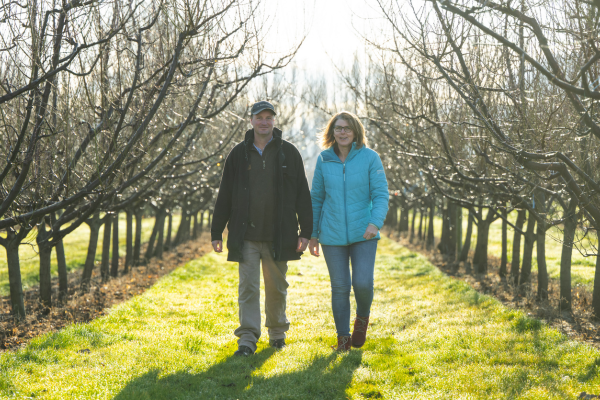
Simon and Trudi share the home with their three teenage children, Cameron, Brooke and Ariana. Simon’s mother also still calls the orchard home, living on a section overlooking Lake Dunstan that was carved out of the orchard as part of the succession process.
Today, the orchard is focused on summer fruit (apricots, nectarines, peaches and plums) and pipfruit (apples and pears). Other improvements over the years include a new packing shed and cool storage facilities, planting new blocks of land, staff accommodation for 50, excavation of a large-capacity irrigation dam and a roadside store.
The call of the family farm
The Webb family history reveals four generations of husband-and-wife teams stepping up to continue the family legacy, too often in response to a premature death in the family.
Simon’s desire to continue the family legacy goes back to childhood. “I was brought up on the place and all through school and things worked on the orchard. It was probably when I was 14 or 15 that I was like, right, I’m gonna be a fruit grower and sort of set my mind to that,” he says.
Simon and Trudi met at Massey University in Palmerston North. Simon graduated with a Postgraduate Diploma in Applied Science (Horticulture) and Trudi a Bachelor of Applied Science (Horticulture) with first-class honours.
Seeking the classic Kiwi OE, the couple worked in orchards and pack houses in Canada before moving on to England where Simon and Trudi were employed by an apple importer.
The Canada opportunity had come about from a travelling Canadian orchardist that Simon had met while in New Zealand, who turned out to be the biggest cherry grower in Canada at the time, working off about 50 hectares.
This international experience and exposure to different horticultural practices helped Simon and Trudi develop a broader skill set, which they brought back to the family orchard.
“I’d always told Dad I was going to come home and take over the orchard. So he knew where I stood. While I was in the UK, the old man gave me the call and said, ‘Mate, I’m over this – you better get home’,” Simon explains.
“He was in his 50s at the time and had probably run out of enthusiasm for it. The industry wasn’t exactly on a high at that point in time.
“My brother was already home working in the orchard, so I came home and did a bit of a swifty on them. I went to
work for the Canadian, who had since bought a property in Cromwell, and ended up working about a third of my time for the old man and two-thirds developing the orchard for the Canadian.
“Working on the family orchard, you learn your old man’s skills and ways of doing things, but when you work for someone else, you learn their skills too and then bring them back into the family. The outside perspective makes you a much better manager, having a broader mindset.
“After I’d been doing that for three of four years, the old man said, ‘Right, I am over it now – it’s time to get home’.
“And I said, alright, I’ll come home but we need to negotiate what’s going to happen.”
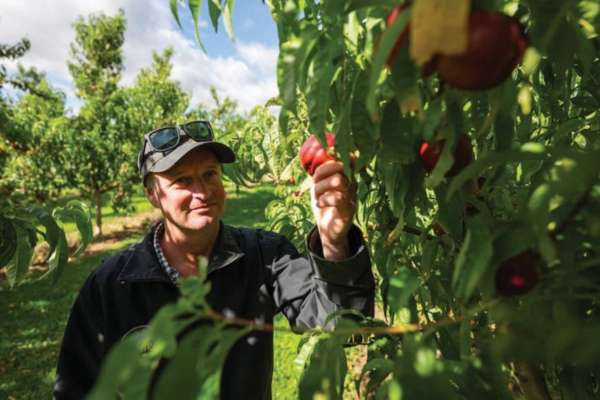
Succession planning
The succession plan for the Webb family orchard initially involved Simon and his brother. However, his brother quickly decided to step out of the family business, believing the orchard couldn’t support three families.
Simon and his parents negotiated a 50/50 ownership structure, with Simon taking on management responsibilities and working out a repayment plan for his parents’ share over time. Together, they expanded the orchard to 25 hectares, built new infrastructure and later negotiated a lease to more than double the orchard’s size to over 50 hectares.
The financial arrangements included a family loan and a structured repayment plan, ensuring Simon’s parents received interest and principal payments while allowing Simon and Trudi to manage the business effectively.
“Succession planning was all done around the kitchen table. We talked about bringing experts in but quickly decided that was a stupid idea because it would cost us a lot of money that we didn’t have,” says Simon.
“I paid an accountant to go through the old man’s books and got some advice from a lawyer. Their advice was that buying into the business was a stupid investment, which was good to know. But I wanted to be in fruit, be my own boss and realise my own aspirations and dreams, so I ignored them and went ahead with it anyway.
“Talking to the old man and my Mum around the kitchen table, I suppose the biggest thing was sorting out what everyone wanted.
“We had some pretty heated discussions around the table.
The old man would get a bit red in the face every now and then, but Mum was the peacemaker and would calm everyone down again.
“Once you actually listen to what everyone’s got to say and you take the emotion out of it, you realise everyone wants the same outcome. Then it’s about stepping back from there and making it viable for everyone.”
Lessons learned
One of the key lessons the Webbs learned from the succession process was setting clear expectations, but all sides have to be willing to accept a bit of give and take along the way.
“We had to work through what was going to work on both sides of the fence. One example was that I didn’t take the wage of an orchard manager, but then Dad didn’t get paid a full wage either. It wasn’t going to work if I was taking a full manager’s wage out and if Dad was getting paid interest and principal and a full wage.
“So we both had to concede as it was better to be reasonable. My mindset was that I’m not an orchard manager. I’m an orchard owner and it’s very different.”
Keeping the family’s best interests in perspective was also one of the keys to the Webbs’ successful process. For Simon’s father, keeping the orchard in family ownership was the priority, but he was also concerned with making sure that, after a lifetime of trying to build wealth, he and his wife would be sorted in retirement.
“Dad was a little intimidated by what was going to happen in the future. He’d built up a bit of wealth but was worried that it would erode with inflation. Then with the 50/50 ownership structure between us, he was only going to get 50% of the capital gains, then eventually [as the principal on the family loan was paid down] get no capital. So you need to make some concessions and make sure Mum and Dad are sorted.
“You want to make it a commercial conversation as much as possible, but at the same time, you are dealing with family. The last thing I would have ever wanted was to see my parents destitute at an older age or without a bit of wealth to share with my siblings.”
For the Webbs and the 100-year family heritage on the orchard, taking emotion out of the process was easier said than done.
“There was a lot of emotion in the transaction for my Dad, keeping the family history alive. But my mother was a calming influence, she took the emotion out of it, telling us all it is what it is. She treated it more like a business transaction.
“Having someone there to take the emotion out of it was really beneficial, because as soon as it becomes emotional, logic has gone out the window and you start only thinking about yourself.”
The final important lesson the Webbs took from their experience was the value of starting the succession process early. Simon and his parents began planning when he was in his mid-20s, which gave them plenty of time to implement changes and build equity. This early start allowed them to make decisions without the pressure of time constraints and navigate unexpected challenges such as illness taking John Webb’s life at age 65 in 2012.
“Dad became unwell when we were doing the second stage of the succession process, which was sad. But I think it gave him a lot of comfort to know that he had seen it through and that Mum was right for the future and so was the orchard. He was pretty proud of the orchard.”