
Posted on
14/04/2026Terry and Gemma Adams farm in Taranaki, a region long associated with dairy and multi-generation family farms. Today, their interests span three dairy operations: a 50:50 sharemilking role near Kaponga, a fully owned dairy farm a few minutes down the road, and a second owned property near Ōpunake, both operated with contract milkers.
Between them, the farms milk more than 1,100 cows across different ownership and management structures. The couple live locally with their two children, Maddie 13 and Brock 11, and continue to balance hands-on farming with a diverse range of business interests.
Finding their own path
Unlike many farming businesses in the region, the Adams’ path into ownership has not involved a traditional family farm succession process.
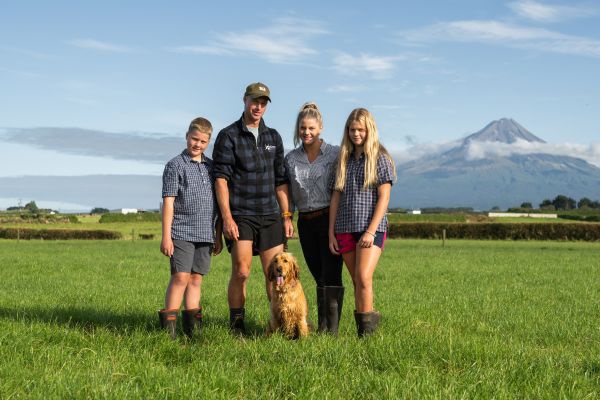
Instead, it has been built gradually through sharemilking, equity partnerships, and out-of-region investment, alongside the development of an off-farm business. Their first exposure to land ownership came through an equity partnership in the Wairarapa, several hours from where they were living and working at the time.
That early investment was followed by the purchase of their first wholly owned dairy farm in June 2022 and a second in June 2025, while they continued sharemilking.
Terry grew up on a dairy farm, but there was never an expectation that he would one day return to take it over.
“Mum and Dad sold the farm about 18 or 20 years ago,” he says. “So, there was never really an opportunity there. If I wanted a farm, I knew I had to do it another way.”
That understanding shaped his decisions early. In his early twenties, Terry bought his first herd with bank finance and stepped into sharemilking soon after.
“I did one year on 21 percent,” he says. “I was doing everything myself and thought, what’s the point in working this hard for 21 percent of the cheque? If I owned the herd, I’d be getting 50 percent and doing the same amount of work.”
Gemma was studying computer graphics at the time. The two had known each other since high school and managed a long-distance relationship while Terry farmed and Gemma completed her degree.
“I’d come home every weekend,” she says. “It was only an hour away, so it was doable.”
Learning along the way
They built their farming careers alongside starting a family. During a nine-season sharemilking role on a larger property, they were managing around 500 cows, employing staff, and raising two young children.
“That was a big jump for us,” Terry says. “I’d always worked on my own before. Suddenly you’ve got staff, systems, rosters. You learn pretty quickly.”
Gemma says the early years highlighted the importance of communication.
“We thought we were good people to work for,” she says. “But once we got into it, we realised we weren’t actually very good at explaining what we wanted.”
She found that verbal instructions often created confusion, both between her and Terry and with staff on farm.
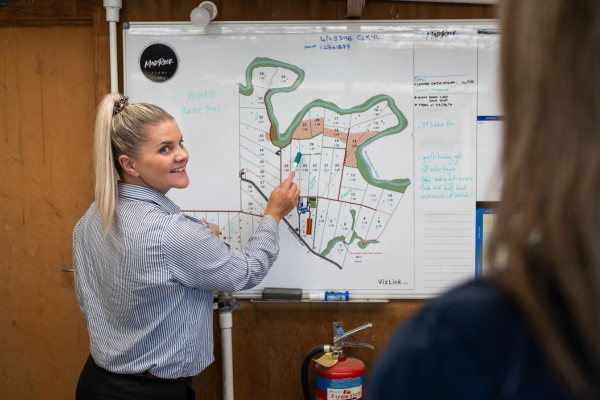
“I need things visually,” she says. “If Terry tried to explain something verbally, I just didn’t get it. But if he showed me a map or a diagram, it made sense straight away.”
She began creating simple visual tools to support communication on farm, including maps, layouts and clear visual instructions. What started as a practical solution grew into VizLink Visual Communication, and Gemma and her team now work with farms across New Zealand and Australia.
I come from a family with commercial businesses,” Gemma says. “So I’d seen how communication works outside farming. I just thought, this doesn’t have to be this hard.”
While Terry focused on the day-to-day farming operation, Gemma built VizLink alongside raising their children.
“It’s my creative outlet,” she says. “And it actually feeds back into how we run our farms. Clear communication makes everything easier.”
Their first step into land ownership came while they were still sharemilking and did not happen locally.
Rather than waiting for an opportunity in Taranaki, the couple entered an equity partnership to purchase a dairy farm in Pahiatua.
“It was never about moving down there,” Terry says. “It was an investment opportunity. A way to get on the property ladder earlier than we otherwise could have.”
The farm was operated by a contract milker, while Terry continued hands-on sharemilking in Taranaki. Oversight was done remotely, with regular phone calls and frequent site visits.
“I’d milk in the morning, jump in the car, drive three hours, have a look around, talk through things, then drive home and get back quite late,” Terry says. “I would be doing that every few weeks so I could stay close to what was happening there.”
“We knew it was hard,” Gemma says. “But it gave us exposure to land ownership earlier than waiting would have. And it taught us how to manage something we couldn’t see every day.”
The partnership included Gemma’s uncle, who already owned farms in multiple regions.
“He’d done it before,” she says. “So he understood what it was like to manage farms out of region. That experience helped us a lot.”
Building on a solid foundation
Over six years, the operation grew in scale. When the time came to sell, the market moved quickly.
“It sold almost straight away,” Terry says. “The timing was right.”
In June 2022, the couple sold out of the equity partnership and purchased their first wholly owned dairy farm, located just five minutes from their sharemilking operation.
“That was massive for us,” Terry says. “It was our first farm. Our decisions. No meetings. No waiting for approval.”
“I’m quite hands-on,” he says. “Being able to just pop down and see what was going on took a lot of stress out of it.”
The farm was placed with a contract milker, with a strong focus on infrastructure and layout.
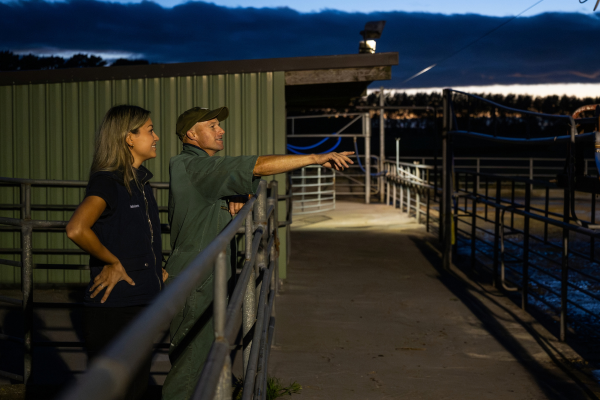
“We’ve lived in rundown houses and worked in really poor sheds,” Gemma says. “So, we were very clear about what we wanted to offer someone else.”
“We were still committed to our 50:50 job,” she says. “So the farm had to be set up properly for someone else to run it well.”
At the same time, the couple refinanced and moved their banking relationship to Rabobank.
“We’d tried to get in earlier but weren’t in a strong enough position at the time,” Gemma says. “When we finally moved across, it felt like a better fit.”
With Rabobank, there’s an understanding of farming over decades, not just years,” she says. “That makes a big difference when you’re trying to build something.”
Their relationship manager became a regular presence on the farm and in the broader regional community.
“He comes along to community events,” Terry says. “He knows what we’re trying to do.”
In June 2025, just three years after buying their first farm, Terry and Gemma settled on a second dairy farm near Ōpunake. Once again, the farm was placed with a contract milker while they continued their sharemilking role.
“We never thought we’d be looking for a second farm that quickly,” Terry says.
The growth has been measured rather than speculative.
“We’ve just kept our heads down for a long time,” Gemma says. “Paying off debt. Doing what we needed to do.”
“He does the farms,” Gemma says. “I do the business.”
“It’s taken years to get here,” Terry says. “None of it happened overnight.”
Their path to ownership has not followed a traditional line of succession. There was no family farm to return to and no single handover moment. Instead, ownership has come through partnerships, distance, dual incomes and steady progression.
Only recently have they begun to consider the next stage.
“It’s just been about keeping momentum,” Terry says. “One step at a time.”
Key lessons from Terry and Gemma's experience
Start where you can, not where you wish you could
Equity partnerships and out-of-region investment provided earlier exposure to land ownership than waiting for a local opportunity.
Treat people, systems and infrastructure as core assets
Clear communication, good farm layout, and well-maintained infrastructure were non-negotiables to ensure good performance and staff retention.
Match debt levels to operating capacity
Maintaining a 50:50 sharemilking income while placing contract milkers on owned farms allowed borrowing to be supported by reliable cashflow.
Plan for growth over decades, not seasons
Refinancing and investment decisions were made with a long-term view of ownership progression, rather than short-term market conditions.